Subterranean termite soil defense targets the continuous moist sand profile typical of coastal Pinellas County. Eastern subterranean termites construct earthen shelter tubes from the water table up to structural sill…
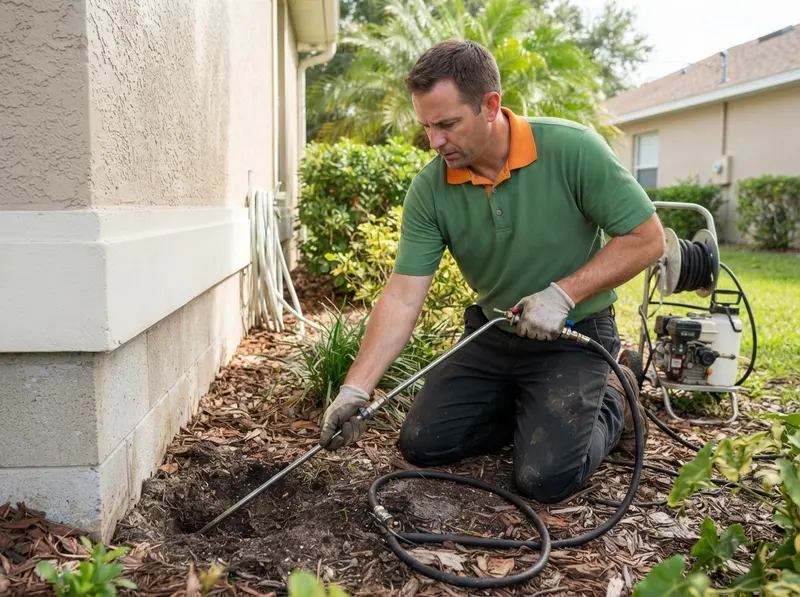
Subterranean termite soil defense targets the continuous moist sand profile typical of coastal Pinellas County. Eastern subterranean termites construct earthen shelter tubes from the water table up to structural sill plates, especially during humid cycles following high summer rainfalls near Tampa Bay. Properties in low-lying sections such as Shore Acres, Coquina Key, and Snell Isle feature persistently damp substrate that sustains subterranean foraging activity without requiring immediate wood-to-ground contact. In older architectural districts like Old Northeast and Kenwood, crawlspace footers and ground-level stem walls sit directly against landscaped dirt, requiring careful soil trenching that delivers liquid termiticide into the upper 6 inches of topsoil without disturbing delicate root zones or ornamental plantings.
A continuous soil barrier functions differently than localized bait stations or topical wood sprays. While baiting systems rely on random subterranean worker discovery over multiple weeks, a liquid soil barrier binds to the soil particles surrounding the concrete footing, creating a seamless, undetectable perimeter zone. Foraging workers unknowingly traverse the treated sand, collect the active agent on their cuticles, and distribute it through the entire underground nest via grooming behavior. In properties with wrapped brick or slab-on-grade foundations common around Disston Heights, Bayway Isles, and Crescent Lake, treatments require precise micro-drilling through perimeter exterior slabs at 12-inch intervals to complete the barrier where concrete directly adjoins structural lumber.
The trade-off between exterior soil applications and baiting arrays centers on immediate perimeter continuity versus post-installation monitoring. Trenching and rodding require continuous physical soil access along the exterior foundation footprint, meaning dense hardscaping, brick pavers, or wide air conditioning slabs require localized drilling to secure uninterrupted coverage. For homes where landscaping immediately abuts stem walls, carefully displacing mulch beds allows the non-repellent compound to bond directly with mineral soil, preventing premature breakdown from organic ground cover while keeping waterways like Crescent Lake protected from unnecessary runoff.
Every job gets a firm, written price after a free on-site visit.
Tell us about your subterranean termite soil defense job in St. Petersburg and we'll send a clear, written quote, usually the same day.
 Pelican Grove Pest Control